
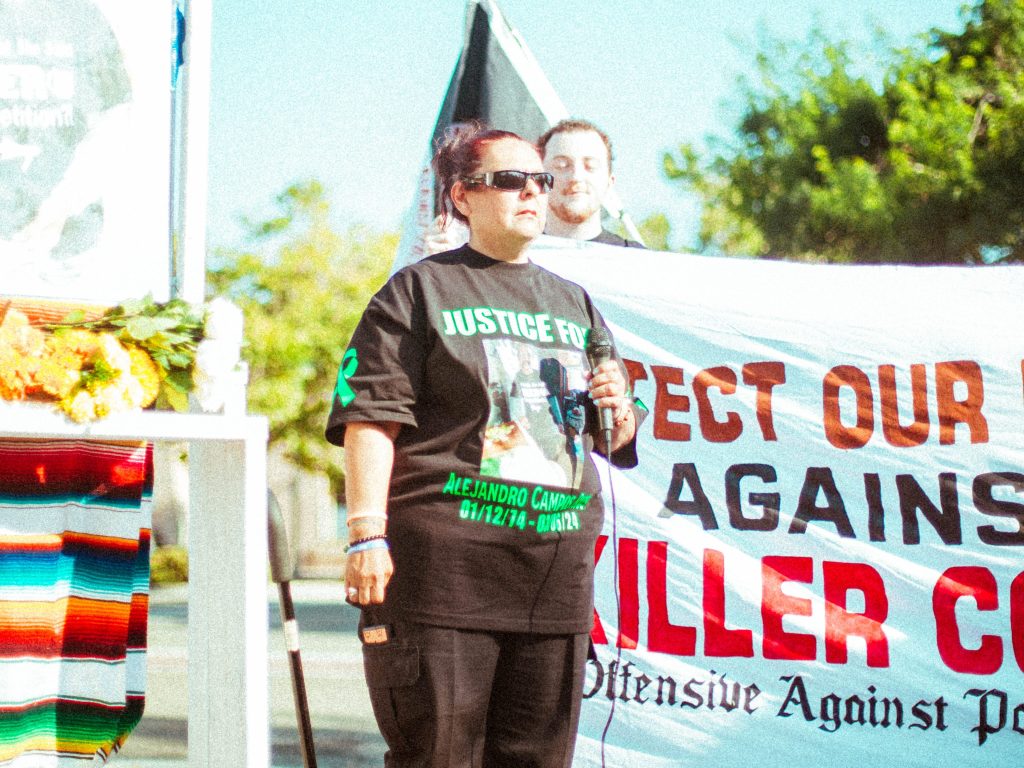
The following is a lightly edited transcript of an interview conducted with Yvonne De La Torre, a founding member of Families Demanding Justice, in Fall 2024.
Dare To Struggle: To start, tell us your name and a little about yourself.
Yvonne De La Torre: My name is Yvonne, and I’m here because I’m seeking justice for my younger one’s father [Alejandro Campos Rios]. He was killed by Fullerton PD, and six officers were out there that morning. He was having a mental illness crisis at that time, but they did not call anybody out there to assist him, so they chose to kill him instead.
DTS: Before we get into all the details of what happened that night, could you say a bit about who Alejandro was?
Yvonne: Alejandro was… very caring. He made sure if somebody was cold, he would give them his jacket off his back. He had a very good heart. He loved his grandkids. He would love to spend time with them, and play with them. Just have a good old time. He was not violent or anything, but in time thing’s happened, and his mind started to change. He was very loving and caring. I know a lot of people would think [that] what he did out there was his fault, but it wasn’t his fault. A couple years before his death, he was diagnosed with very high levels of stress and anxiety,, and he was under the care of a psychiatrist. Obviously they failed him as well. Now we have to deal with the aftermath of him not being here anymore.
DTS: What happened the night he was murdered by Fullerton PD?
Yvonne: It was weird because that day I was on my phone, and there was something on Facebook–a news clipping or something–saying that there was a man in his 50s killed at McDonalds in Fullerton. At that moment, I didn’t even look at it. I don’t know what made me not be curious, because normally I’m very curious, and want to see who it was because I’m very familiar with Fullerton. That day, I didn’t. Until that night, my kids came over, and that’s when they found out it was [Alejandro], because it was a picture shown of him. It was very blurred. It was mainly that picture that [Dare To Struggle] had put up. But they saw it was him.
DTS: So you were not informed? Did you hear anything from the city?
Yvonne: Nobody was informed…The next of kin was my son, and he was told when he was in the county jail at that time, so they informed him and let him know that his dad died. I didn’t hear from anybody. I was just dealing with the aftermath. Just trying to do his services and stuff like that. Then, when they showed me the video I knew right away that they had killed him – that Fullerton PD had killed him – even though you could tell he was having a mental crisis issue at the moment. Instead of giving him time to cool down, or calm himself down, [Fullerton PD] escalated it. From what I’m told, they just rushed it. They didn’t give him time to relax or get himself together. They just kept calling one officer after another. There were six officers out there, five men and one woman. The video plainly shows that [Alejandro] wasn’t all there. He needed help. They chose not to help him. They chose to kill him instead. Otherwise, he’d still be here.
DTS: What were your next steps?
Yvonne: After that, I just started to do his services, get him situated and out of the morgue. I chose to seek legal advice.
DTS: Was the legal advice helpful?
Yvonne: Yes, right now we’re in the process of going after the city. Everything’s on a waiting game.
DTS: How did you get linked up with Dare To Struggle and getting into protesting?
Yvonne: I got involved with Dare To Struggle because [two members] came to Alejandro’s memorial service, and that’s how I got in contact with them. And I’m helping them to help other families out there in the same situation.
DTS: Can you talk a bit about the protest we held in July for Alejandro and the other victims of Fullerton PD? Were you aware that this was something FPD did repeatedly?
Yvonne: I was aware of when they killed Kelly Thomas. I actually lived in Fullerton when that happened, so I was well aware of what happened to him, and what they did to him was wrong. Of course, the officers were never [convicted]. Their family sued as well, but that doesn’t bring any closure. We can get as much money as we can from the city, but it doesn’t bring closure–it doesn’t satisfy the family because the family wants justice. These officers, just because they wear a badge, doesn’t give them the right to kill anybody. And if they’re unarmed, and they’re killing them, that’s obviously totally wrong as well, because they can’t defend themselves. Alejandro had a belt. What can a belt do to an officer that has full gear on? Kelly Thomas had nothing. He didn’t have anything… these officers are trigger-happy. Regardless if they’re homeless or not, they still have family who care for them…
DTS: You have the button on that says “Send the Killer Cops To Prison”, do you want to talk about that?
Yvonne: Of course, that’s my goal: to bring awareness that these officers need to be held accountable for their actions. Most of these people who are being killed are unarmed – they have nothing! They don’t choose their outcome in life. They’re just walking down the street, they have an episode – this shouldn’t cost them their life, because they’re asking for help. If these officers don’t know how to help them, then they shouldn’t be going out to the calls. They should automatically be redirected to somebody else who can assist these people having mental health crises, because obviously they just want to come out to kill people, and that’s not right.
DTS: What have you been doing recently to work towards that goal? What happened on October 22, the national day of protest to stop police brutality?
Yvonne: On October 22, we took it out to the streets. We went to downtown LA with other families as well in the same situation that their family members were killed by law enforcement. I connected with a lot of family members in California, and now we’re trying to expand it out to New York, Connecticut, New Mexico, The Bay Area, and other states. Something needs to be done – these politicians, everybody–they’re all corrupted. A lot of it is being covered up. By talking to these family members, they talk about their cases, and a lot of it is cover-up. All of this needs to be exposed. It’s not fair and it’s not right. If it was one of us that did this to somebody, we would already be in jail for life. We would already have been prosecuted for what we did, if we killed somebody. Just because they’re officers, they need to be held accountable. There should be no cover-up on anything. If you take a life, that person needs to be like one of us. They need to go through every single step as if they were a regular person. It’s not fair that none of these families are getting justice because a lot of politicians, and all these people all the way up to the steps that are following them and covering up their mistakes. They need to be exposed.
DTS: Recently, a new organization was formed called Families Demanding Justice (FDJ). What is it, what is it trying to do, and who is involved?
Yvonne: Families Demanding Justice is an organization that we started with a lot of the families that came out during O22 throughout the United States, as we are demanding justice. We’ve been seeking families in other states as well to make this a huge organization to demand justice for our family members. A lot of these officers are still on the force. Some of them got promotions. We’re just trying to all connect and make one big unity, to make noise, and make changes so that this doesn’t happen to other family members, and them going through the same issue… a lot of them going back 4, 5, 10 years still have not got justice. They may have been awarded [through the] lawsuits, but still that doesn’t bring back their family member. What they mainly want is justice – that these officers need to pay for their crimes that they’re doing. It’s not fair that they’re still roaming around as our loved ones are gone, and they don’t pay the consequences.
DTS: What’s the significance of the family members themselves stepping up as leaders in this –speaking up themselves, and raising these just demands, like punishing these killer cops?
Yvonne: The significance of Families Demanding Justice is for us all to unite as one to make a difference. The more people we can get involved, the more that they’re gonna hear us, and see that there is an issue. A lot of it doesn’t get heard if it’s only one person. If we unite all these families as one, then they’re gonna have to hear, and take notice that there is an issue out there–that these departments need to be held accountable for killing people and harrassing them as well.
DTS: What are some things that Families Demanding Justice is planning in the future?
Yvonne: We’re planning on trying to be there for other family members as they’re having their “angelversaries” to show that we are here for everybody who’s impacted. I just went out yesterday to a six month “angelversary” as they call it–the person’s been gone for six months. We just go out and support other families to show that we’re all together and we’re all united in this fight for justice for our family members. The more that people come out to support people, the better they know that we’re not going anywhere. They can’t force us out. We’re here for life. We’re gonna make a change. We have to make the change. The only ones who can make the change is the impacted family members, not the organizations or people trying to benefit off of family members that are killed…
DTS: At O22 and leading up to that, you were often chanting “Fuck the police!” Has that always been how you felt about the police, or how has your view changed over time?
Yvonne: My view has changed over time. I was never that person to say anything like that. I was mainly pretty much quiet. I was always scared to speak out. Now, I don’t care. These officers changed my life. I see views in a different way. Before, when I would see somebody getting killed by the police, because they did this or that, I was like “maybe they deserved it”, but when you read about it, and you understand their situation, what they were going at the moment, no they do not deserve this. They do not deserve overkill. More than six bullets is extreme. And then you’re shooting them in the back, and you’re gonna sit there and tell me that it was justified? No. How is it justified when you’re shooting them in the back? It’s just wrong. Totally wrong. We as impacted family members have to make the change, and we have to demand justice, and we have to go all the way to Sacramento if we have to to make the noise to make these changes. Something has to be done. There was another instance of a man at a church having a mental crisis, and [the police] shoot him! These officers have no conscience whatsoever. They just want to shoot to kill, ask questions later. They feel they can get away with it. It’s got to stop now. We don’t want any more impacted family members added on. What we have is already a lot, and we don’t need new ones added on.
DTS: We made that [Stolen Lives] banner with all the faces of the people killed by the police–obviously not all of the faces. You couldn’t make a banner that long. It’s just so many people. And you think about all of the people who are family members just of the people on that banner, you could fill up stadiums full of people if you look across the country. I feel where you’re coming from there. I think the police kill on average three people every day, and it’s getting worse. So, the fact is there’s gonna be a lot more people. Even in the time we’re doing this interview, I’m sure they’re doing some fucked up thing. I wanted to extend appreciation that you’re part of the people that are gonna be there for the people that will go through this, and that are going through this right now. I wanted to ask you: what do you think it says about this system that there is this impunity: that they feel they can just get away with it? Why do you think that is, and what do you think that tells us about the kind of system that people are forced to live under today?
Yvonne: It’s a fucked up system that we have to live in this society. But, I understand that we have to have officers, because there is crime out there, but some of these crimes that are out there shouldn’t take somebody’s life, regardless [of] what they did. Nobody wants nobody to die. Of course, we don’t want anyone else to get hurt. I understand that’s what they fear, but if the person is unarmed, how are you gonna fear for your life? When they have a mental health crisis, [it] means that you need to have a mental health crisis team out there to speak their language, to talk them down. Not to kill them. Most of them, if they had somebody out there to talk to them in their own language that they’re going through in that moment, most of them will calm down and be at ease. When you’re calling the officers out all the time to certain crises, certain things, they have to understand that that triggers them. These officers take advantage of people when they’re sick and need help.
DTS: I heard you say on an outing we did before October 22 where you responded to someone on the trains, “it could happen to you”. What do you want to tell the average person, [for whom] police murder or terror hasn’t touched their lives necessarily? What do you think people need to know about this?
Yvonne: When we were going on train outings in Downtown L.A. promoting O22, a lot of people wouldn’t take flyers, or looked at you like they didn’t want to help or get involved or anything like that. I would say “this can happen to you”. It can happen to anybody. A lot of people think it won’t. I never thought I was gonna be that one person that’s gonna be impacted family. I never thought that I would be the one that’d be out there speaking and getting Alejandro’s name out there, and [helping] other family members as well to be all connected as one. It’s no fun. It’s no joke to be involved in this kinda organization to try to seek something that should have been seeked a long time ago. They’re just letting a lot of people get away with a lot of stuff. It’s just wrong.
DTS: What would you say to people that are in your position that you were at at the beginning of this, just dealing with that loss right after it happens and not knowing what to do next? We’re gonna be reaching out to a lot of these people going forward to give them support. What would you say to someone who’s just lost someone to police?
Yvonne: I would tell them that you’re not alone. That I’m here. I would try to get in contact with other impacted families to get us all together. It is a significant loss. To go through it alone is even worse. Especially when you don’t have family there to get you through it. It’s very hard. When I got with DTS, you guys feel like family because you guys were there when I didn’t have nobody. And we go through all this stuff to get justice. It means a lot. I know some people out there don’t have that support either. So, it helped a lot at the moment I needed the help.
 Families Demanding Justice