
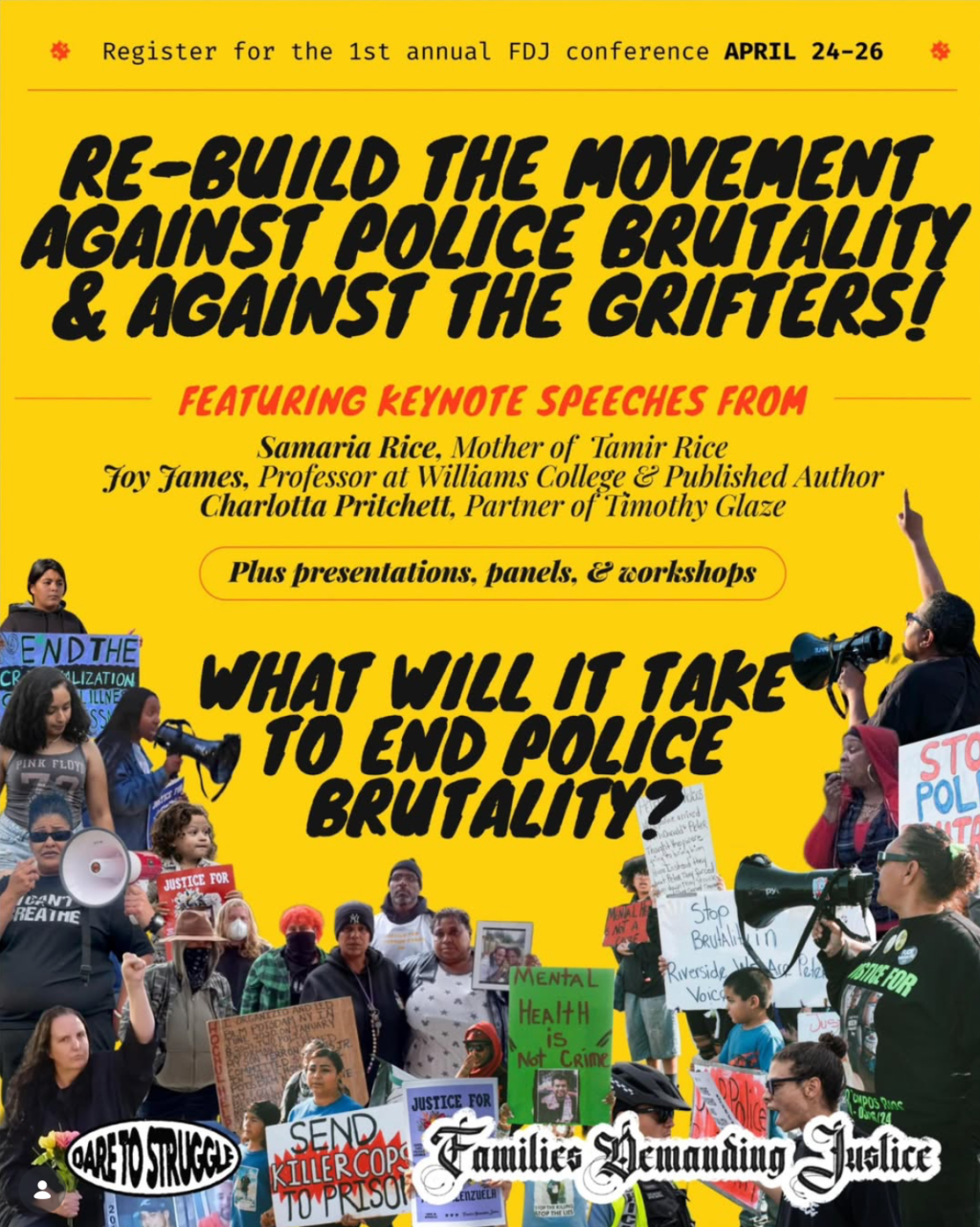
Families Demanding Justice is holding its first ever conference, “Re-Build the Movement Against Police Brutality & Against The Grifters!” this April 24th – 26th in Chicago, IL. The conference is intended to bring together different kinds of people involved or interested in ending police brutality, an unparalleled epidemic in the US that seems to never end. We are bringing people together to discuss the pressing questions our movement faces: What happened to the mass movement against police brutality, and what obstacles exist today in re-building it? A crucial part to this re-building effort is taking aim at the grifters: those who have continuously inserted themselves to the front of the movement, only to use it for clout, profit, or to advance their political careers.
Despite the powerful rebellions against police brutality over the last decade, from Ferguson to Minneapolis, the movements that arise have continually been strangled, pulled, and led into the ground by politicians and opportunists. There’s no better place to focus on this problem than right here in Chicago.
Police brutality is widespread and continuous in Chicago. Since 2000, Chicago police have killed at least 300 people, mostly young Black men, with nearly zero of the killer cops having faced any kind of justice for their crimes. In a city known for its historic corruption, the government and local politicians have historically worked overtime to run cover for the pigs. But with the growing outrage in the streets against police killings in the last several decades, a network has grown with grifters, sellout politicians riding the wave of outrage into political office, and more sophisticated attempts to co-opt the movement to steer it back into the safe confines of the system and business as usual.
In 2014, Chicago police murdered 16-year-old Laquan McDonald, shooting him 16 times from behind. In the subsequent cover-up, Mayor Rahm Emanuel withheld the video of McDonald being executed by the police for more than a year. In the wake of the 2014 Ferguson uprising and ahead of the 2015 mayoral election, the CPD, Independent Police Review Authority (IPRA, the toothless police review board of the day), and Rahm Emanuel attempted to keep the video footage of the police killing of McDonald from public view. The court-ordered release of the footage sparked a series of major protests and created a widespread loss of legitimacy for the CPD and any attempts at reform or accountability. The combination of disruptive protests and the potential for mass rebellion, expressed by the Ferguson and 2015 Baltimore uprisings, posed a real challenge for the rulers of Chicago.
The system had to make moves. What came out of this period was a decade of reforms, activists, lawyers, and politicians who would insist on solving the problems of police brutality within the system itself, all which did nothing to reign in the pigs but merely create the illusion of change.
First came COPA, the Civilian Oversight and Police Accountability board, in 2017 to replace the IRPA. Like previous police review boards (which Chicago has a long history of), COPA is made up of people who are expected to work closely with the CPD, and its chief administrator is always appointed by the Mayor of Chicago, who also oversees the CPD. Even with “more” independence and civilian oversight, COPA is not empowered to fire or discipline the cops who routinely kill and brutalize, instead only providing recommendations to the mayor, police superintendent, and city council. COPA was pushed by politicians, government officials, and activists alike as the solution to holding police accountable. Today, COPA continues to remain as the main institution to file police complaints, but through which ultimately nothing gets done. If you’re lucky, COPA will make a recommendation of a suspension, but at worst, they will further legitimize police killings by stating they were justified.
From the 2010s through 2020, opportunist police brutality activists like the Chicago Alliance Against Racism and Political Repression (CAARPR) had, for decades prior, championed an electoral path to an undefined “community control of the police.” Unsatisfied with COPA, they pushed for further reforms and had a lineup of longtime opportunist operators meeting with Mayor Lori Lightfoot to hammer out the details. In 2020, as the country exploded, Minneapolis burned, and rebellion broke out in Chicago in response to the public execution of George Floyd, CAARPR got some juice and inserted their reformist plan as the main goal of the movement’s direction and what it should be fighting for. In response to the mass rebellion, the Lightfoot-police reformer alliance created a series of 22 elected police district councils, which are only empowered to hold meetings and make recommendations. They also created the Community Commission for Public Safety and Accountability (CCPSA), which holds hearings and makes recommendations to the mayor, including hiring recommendations for the head of COPA, the police board, and the police superintendent.
Advocates for this mind-boggling system claim that, despite the powerlessness of these bodies, they represent something positive because the people who staff them are elected, not appointed by the mayor (who is, of course, elected). All that they have done is create another set of bodies to hold endless meetings that, by definition, cannot deliver justice to the people who encounter them. These powerless bodies continue to project themselves as a solution, with some of their elected members insisting this is what “community control of the police” looks like, while having done nothing to hold police accountable for their crimes.
In the 2023 mayoral election, CAARPR played a big role in electing Mayor Brandon Johnson, and theyhold influence in his administration today. A former Chicago teacher, union organizer, and progressive candidate who campaigned on holding police accountable, Johnson began to campaign in the wake of the 2020 protests, invoking the names of Laquan McDonald and 13-year-old Adam Toledo (who was killed by CPD in 2021) in his campaign speeches. On the campaign trail, Brandon endorsed CAARPR’s latest police reform initiatives, supported defunding the police, and once in office, appointed self-described police abolitionists to top positions in his administration.
But all the marketing fell flat when Brandon took office. Not only has Brandon increased CPD funding year after year, he has done nothing to stop police brutality in this city. He’s refused to do anything about police with known white-supremacist organizational ties, done nothing to stop police from continuously harassing, beating, and killing under his watch, and has done nothing to hold killer cops in CPD accountable, some of whom have been promoted and awarded under his leadership. The so-called “people’s mayor” has refused to even acknowledge the victims of police brutality and their families, having actively ignored their demands and having them physically removed from his events. As a consequence, CAARPR, the self-described police brutality activists in the city, have essentially remained silent on the onslaught of police killings under the Johnson administration and of course refuse to raise criticism against him, because that’s their guy. Brandon “the people’s mayor” Johnson is the definition of an opportunist, riding the wave of the movement to get into office, and continuing business as usual.
Chicago is also home to a host of parasitic lawyers, “ambulance chasers” trying to get on the grift of police murder by pushing for settlements over accountability and justice. While the country has Ben Crump, Chicago has the likes of Cannon Lambert, who has come around impacted families looking for a check, encouraging their silence, and dumping them when the case doesn’t seem profitable. The families of Lorenzo Williams Jr. and Nate Ferjerang are two examples of having to deal with Lambert, who promised to get them justice only to drop them and ghost them later down the road. Lambert positions himself as a hall of fame civil rights attorney, having represented the family of Sandra Bland, and can be found creeping around other impacted families after police kill their loved ones (especially when the cameras are rolling).
What does all this mean for the movement against police brutality? When the righteous rage of the masses reaches new heights in the struggle against police crimes, it becomes led astray by the opportunists and grifters selling lies and promises they don’t intend to keep. What does this all mean for impacted families? Their loved ones’ names are used as tools to pass bills, win elections, and cut checks. Families fighting for justice become re-traumatized and cynical, feeling hopeless in the face of so much opportunism with justice nowhere to be found. This is why we must send a clear message to the opportunists and grifters: re-building the movement against police brutality is taking aim at you, and we will not let our fight be silenced, strangled, and led astray.
Chicago is a microcosm of all this, and the past decade of opportunist leadership is why we are holding our conference here, right in the belly of the beast of police reform. Impacted families in the fight and activists who sincerely wish to build a movement on solid foundations are welcome to come out, learn, and discuss the critical questions before us today.
 Families Demanding Justice
Leave a comment